Welcome to markorear.com, a website dedicated to exploring the O'Rear lineage
Introduction:
Sometimes it’s fun to conjecture as to whether or if you are related to anyone “famous”. With the advent of AI and powerful computer ancestry tools over the past ten years or so, it is now possible through sites such as familysearch.org to determine, almost instantly, your lineage connections to almost anyone going centuries back in time.
Familysearch.com contains a public family tree which allows you to put in your own family tree, but then augments and compares it with the family tree of others. Once I established my own line, it automatically created for me virtually anyone else in the world who is famous that I am related to. Yes, it's incredibly fun and also incredibly addicting. And it changes often as the family tree contains more and more people
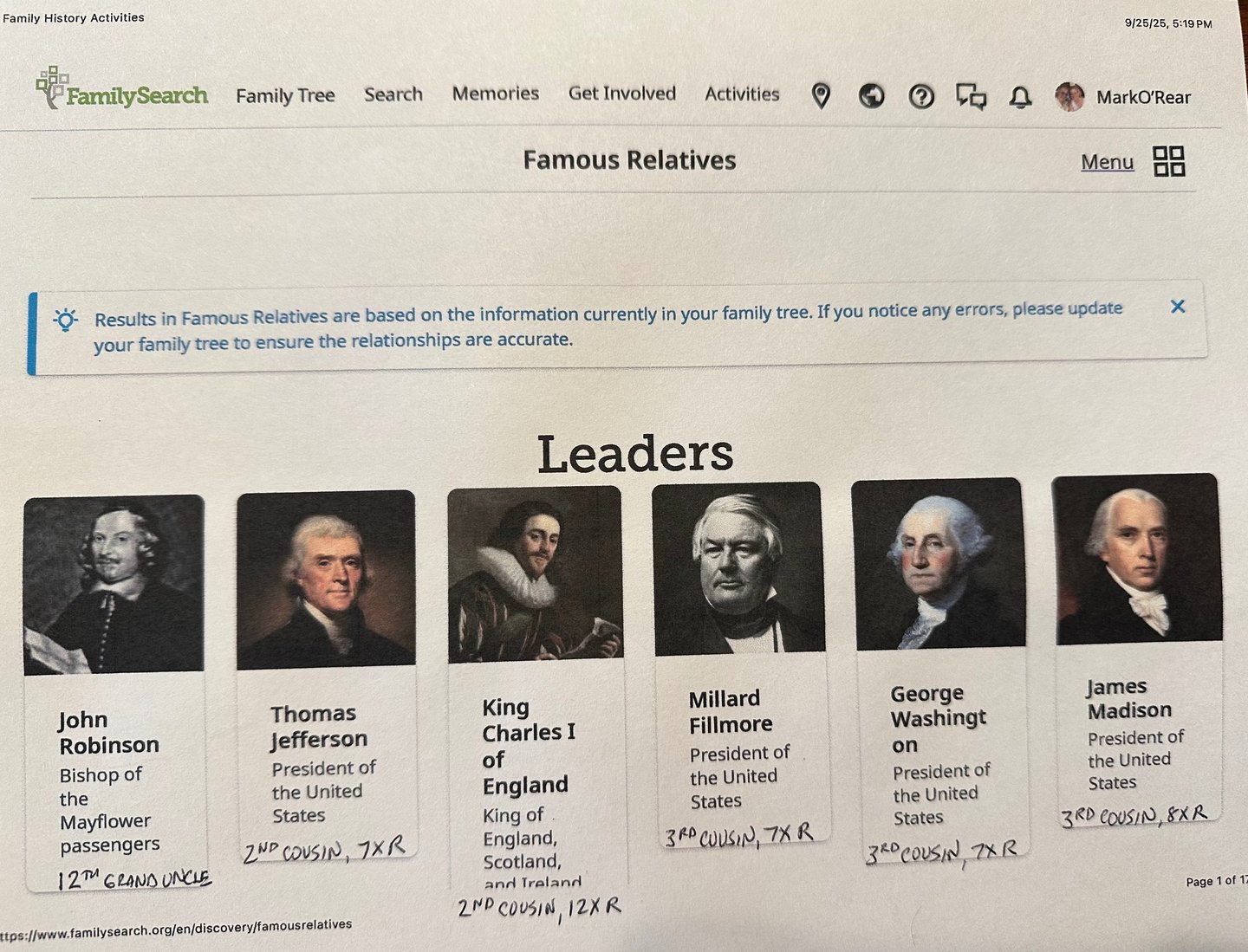
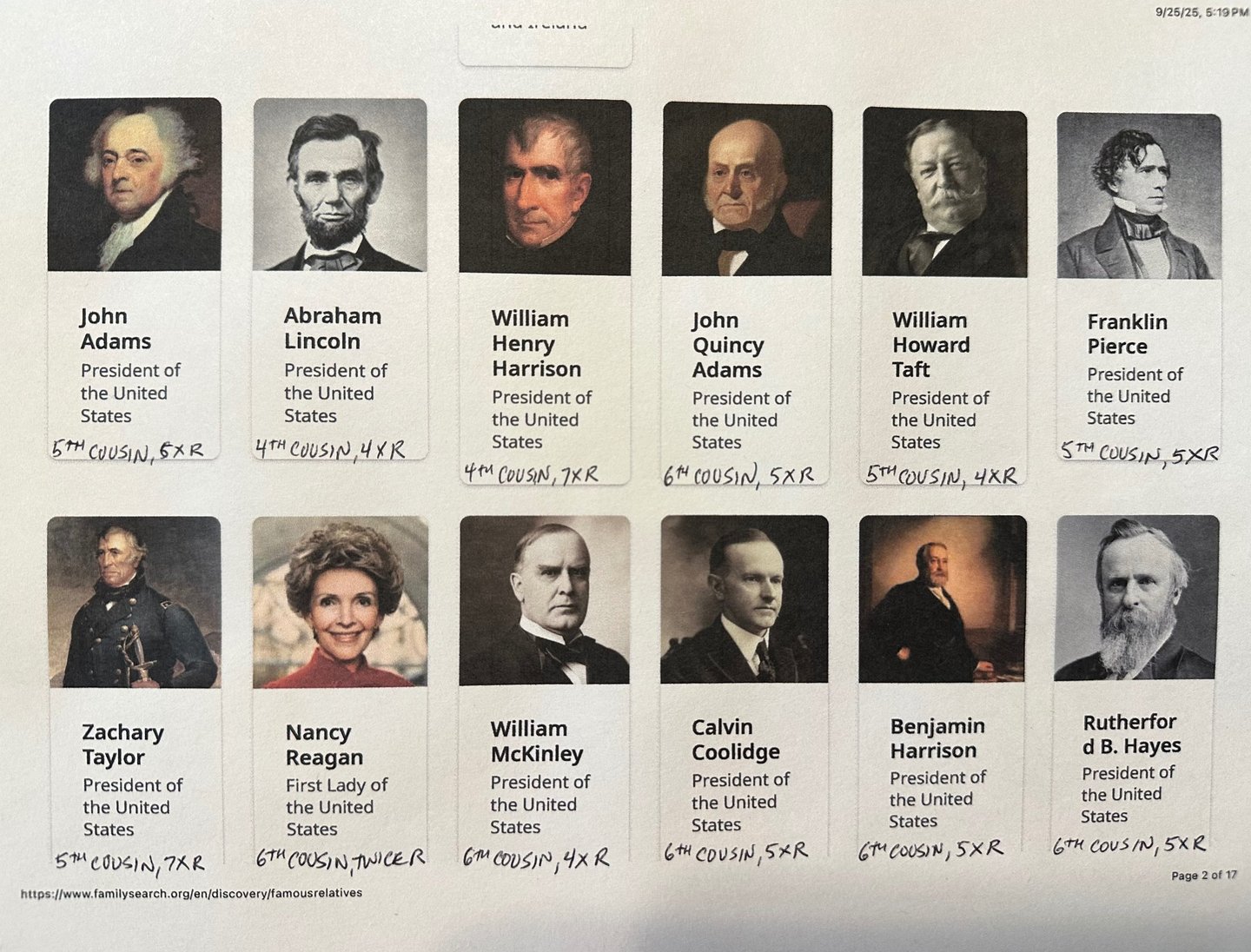
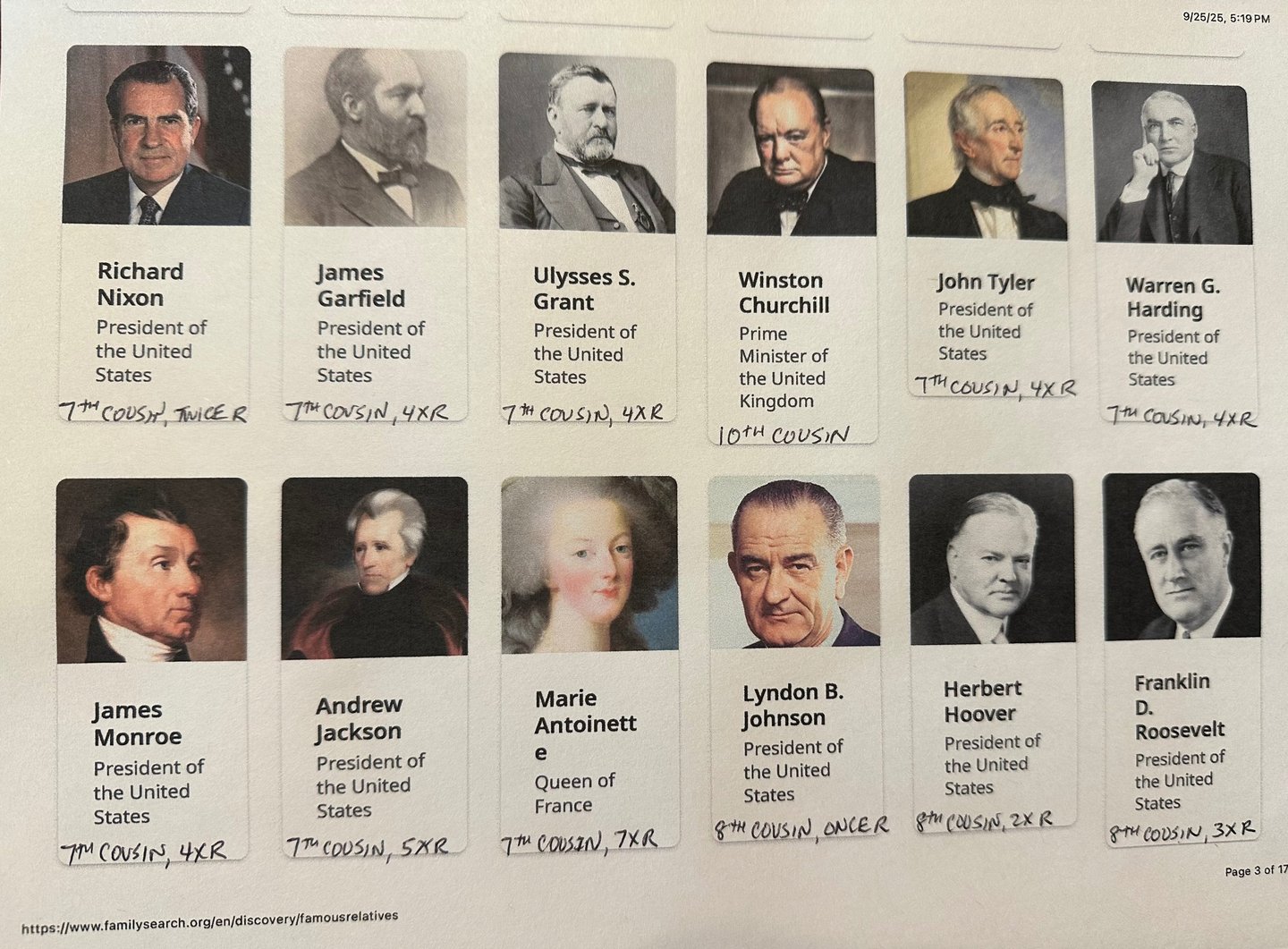
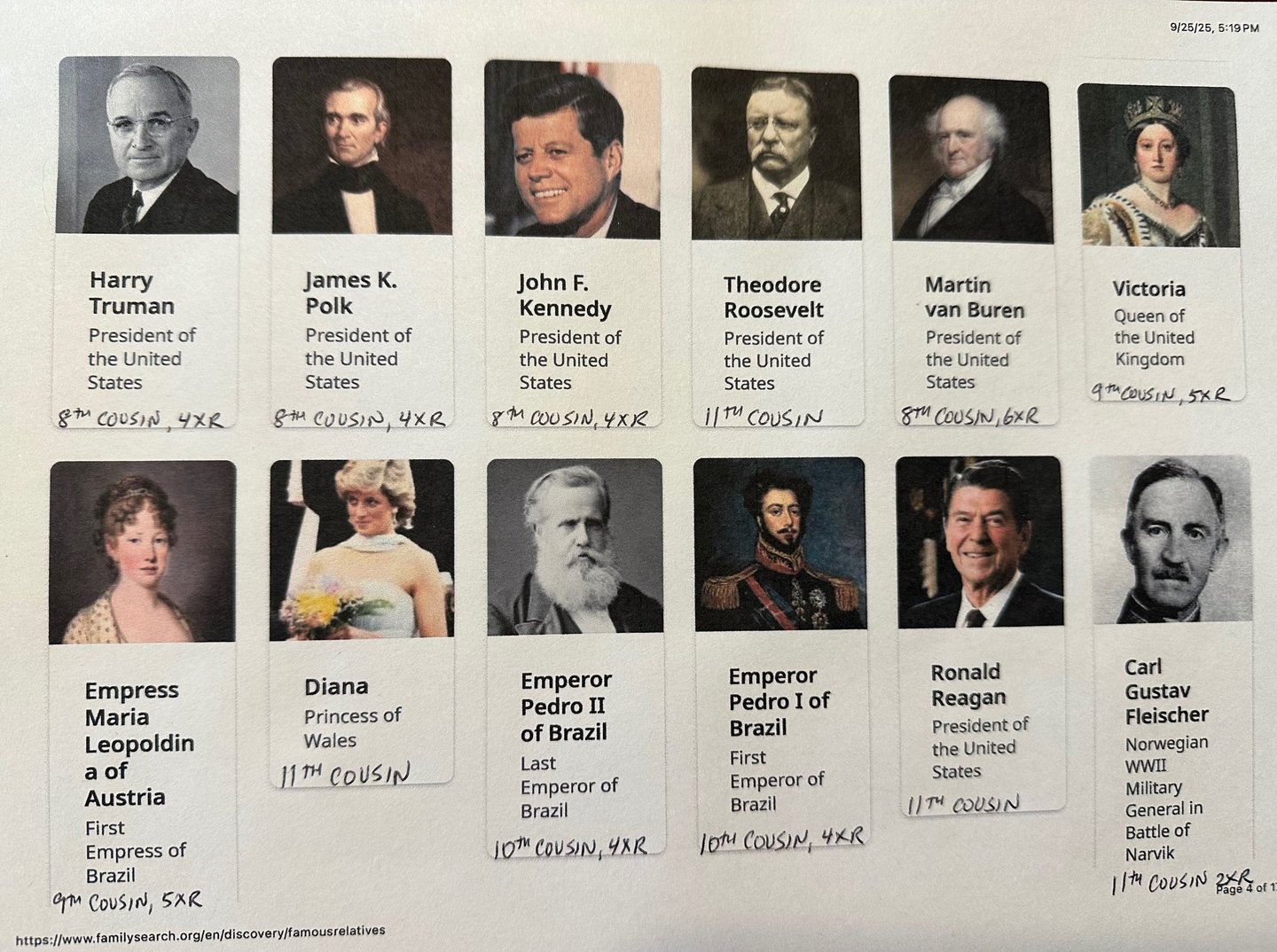
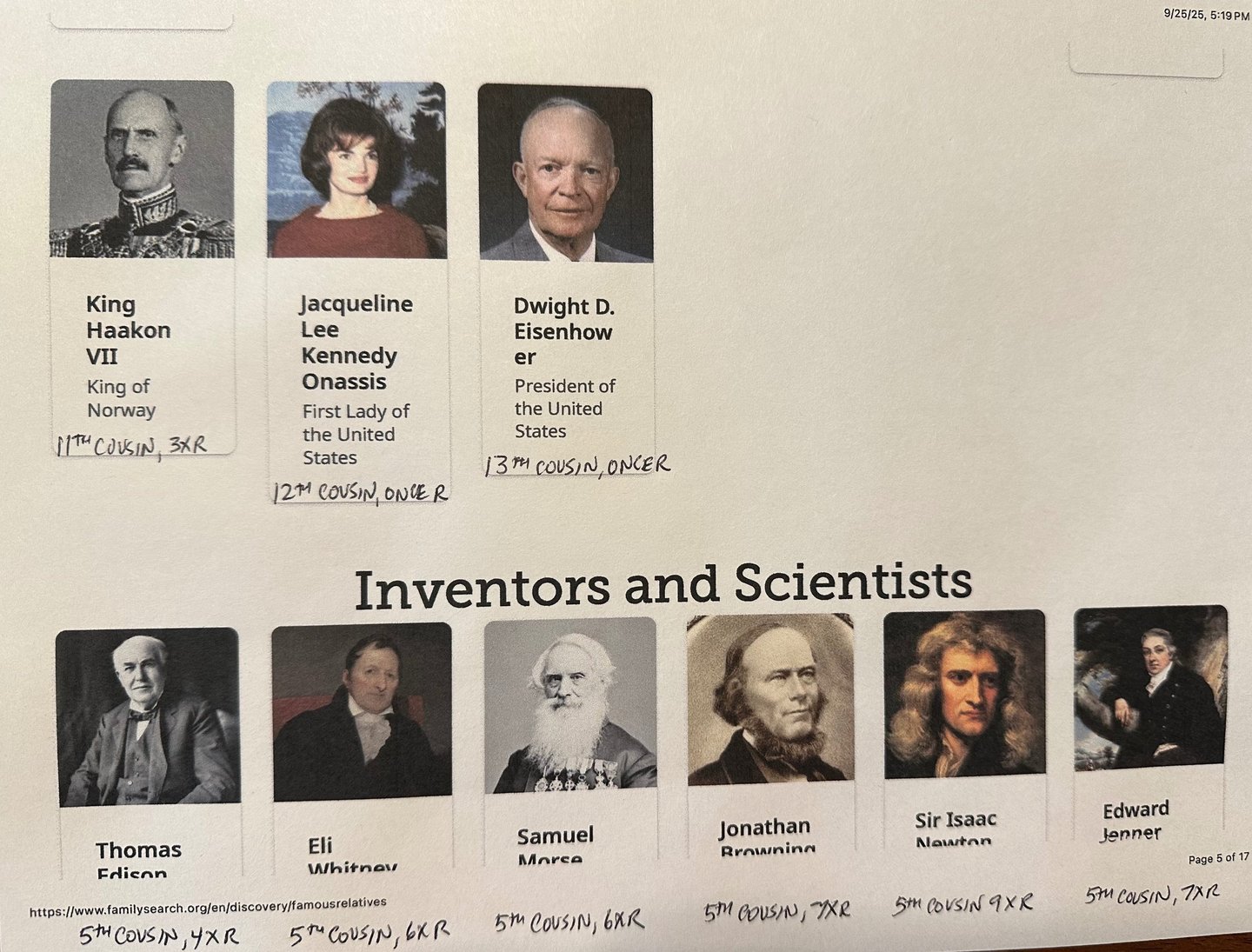
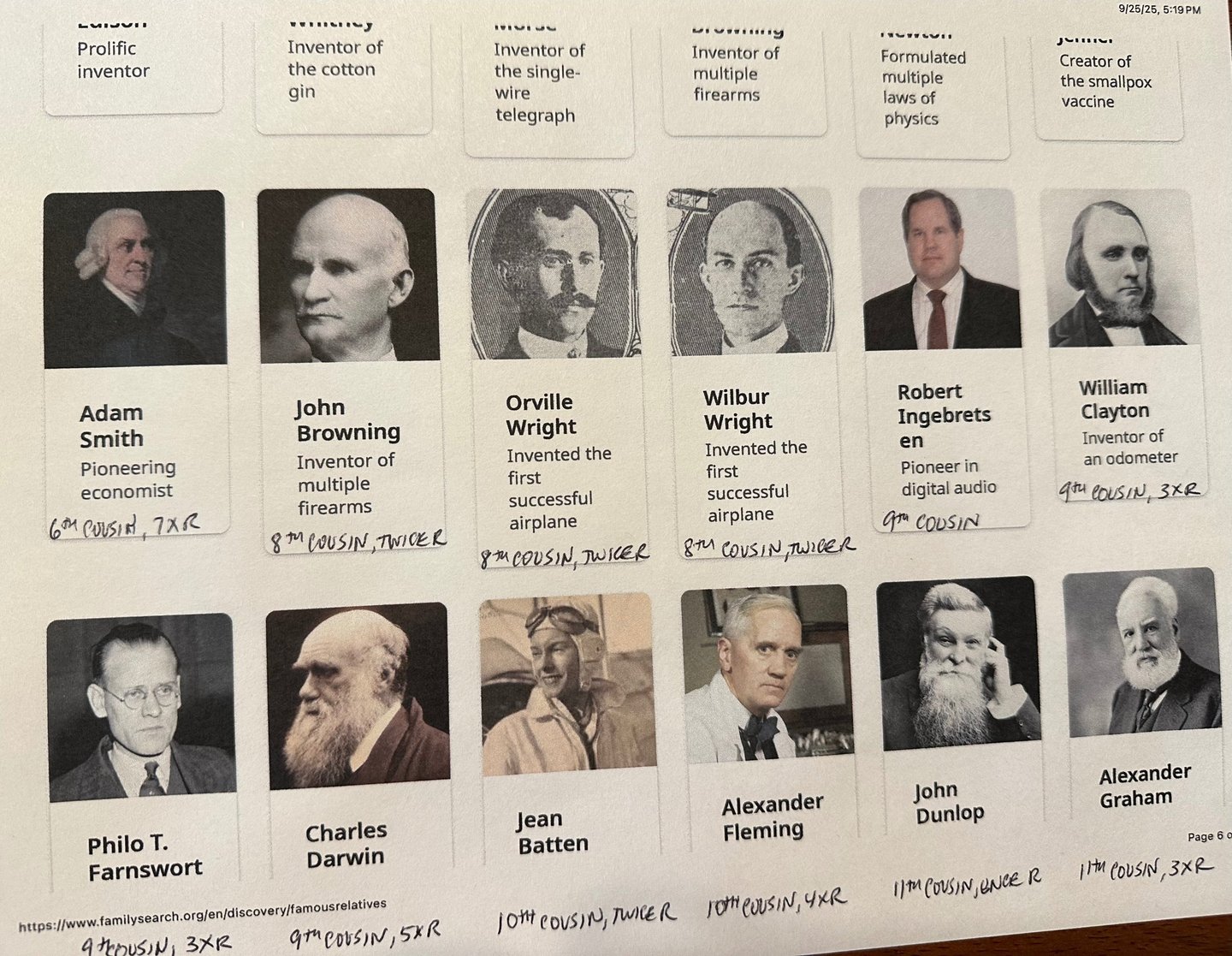
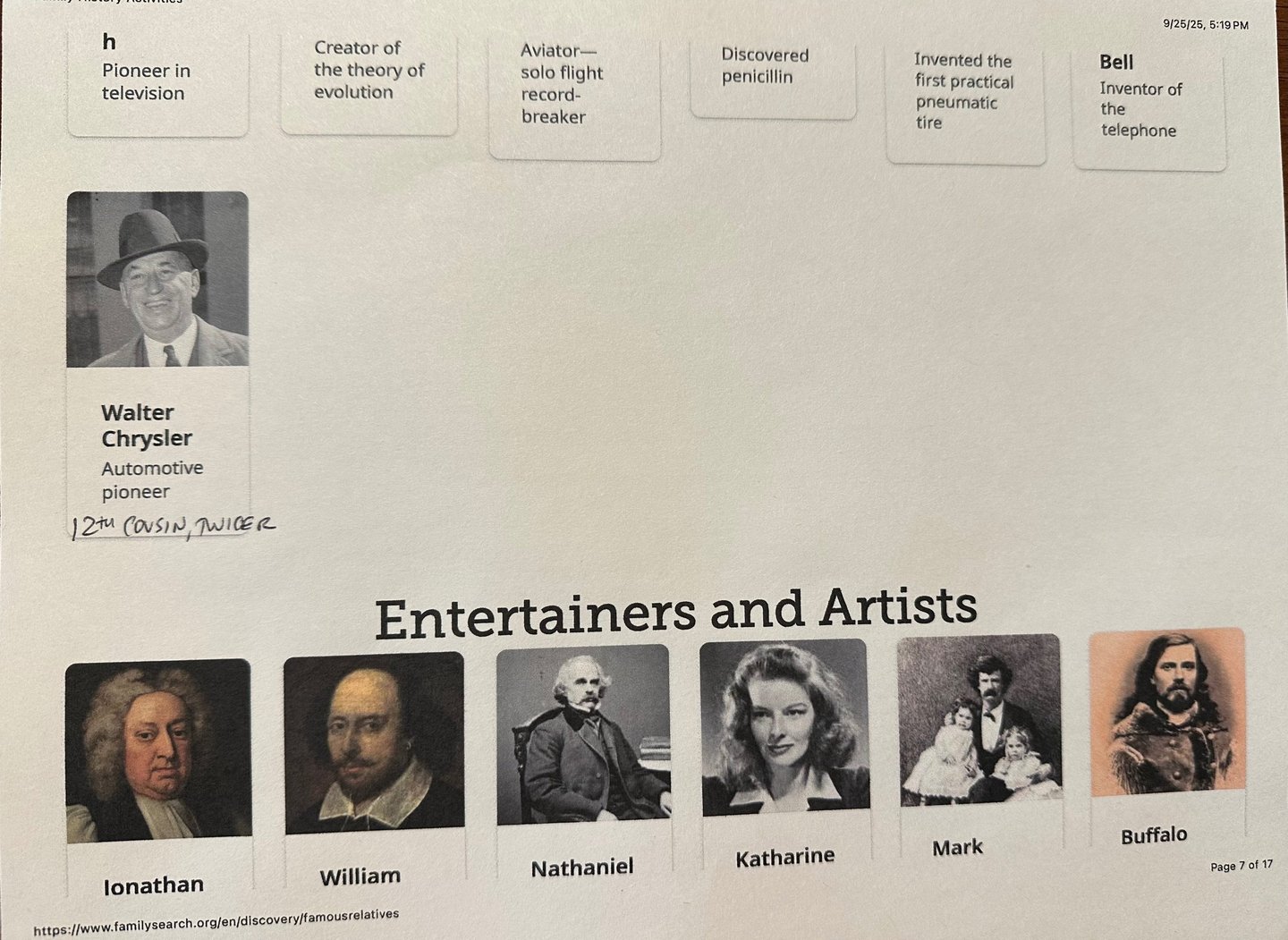
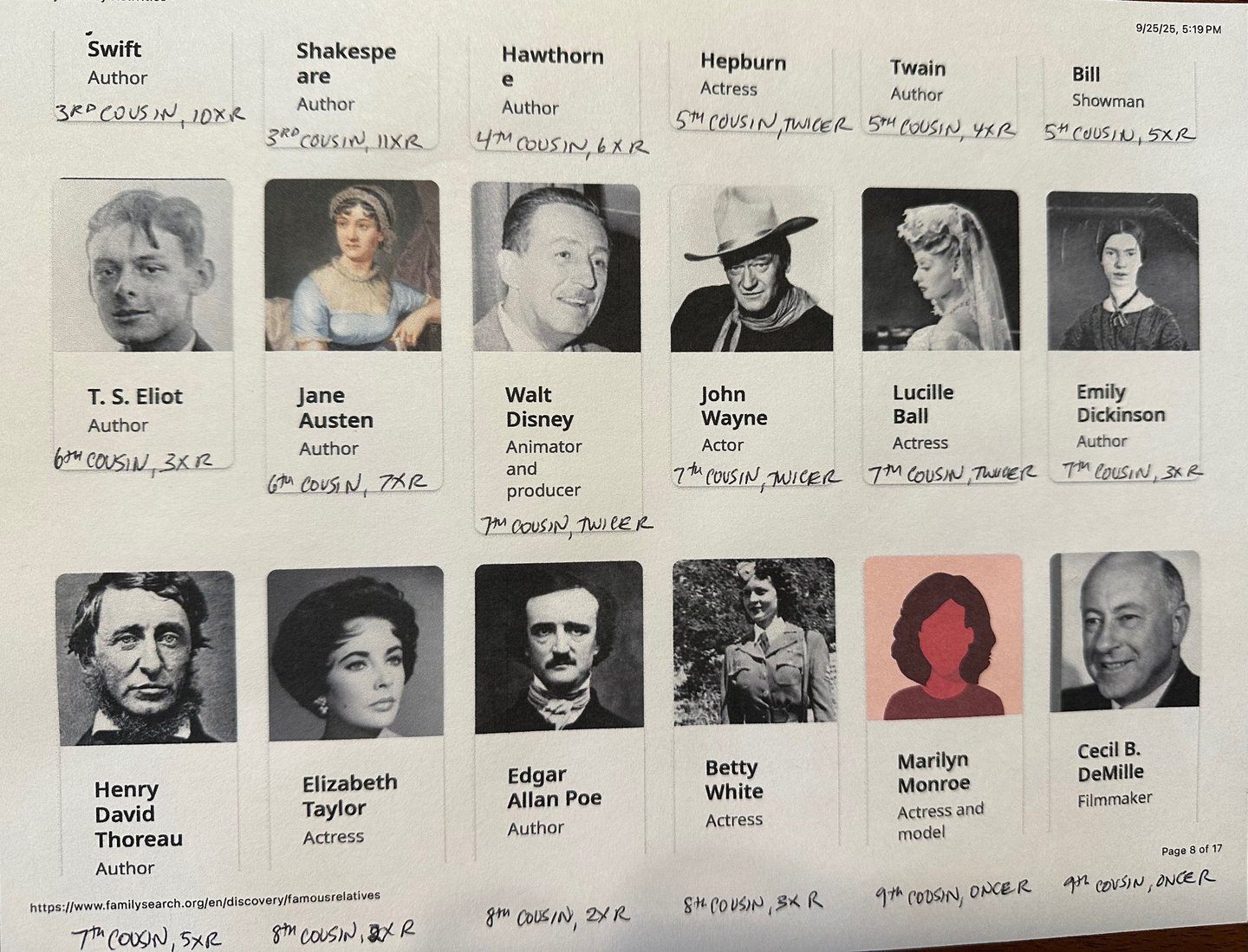
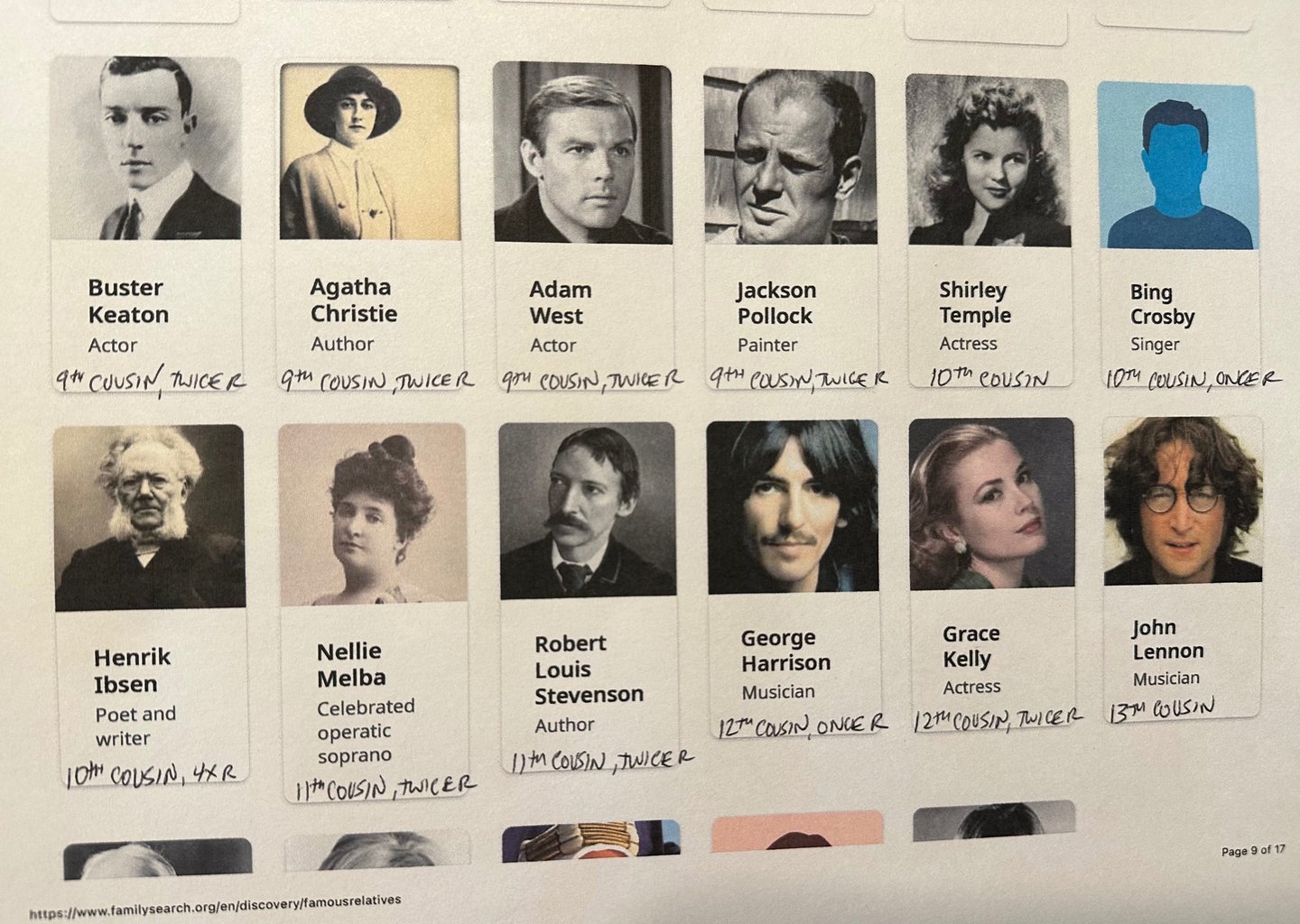
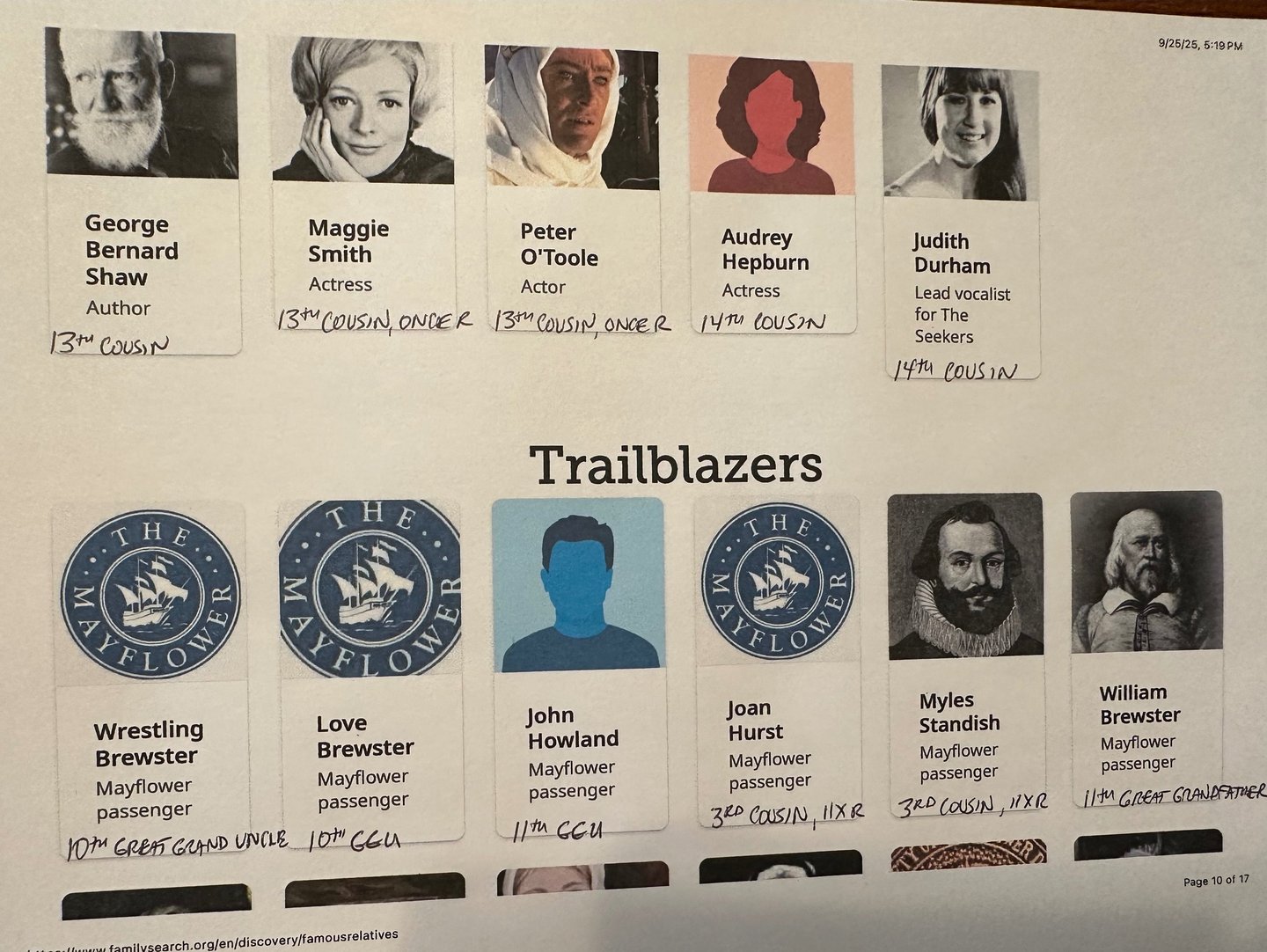
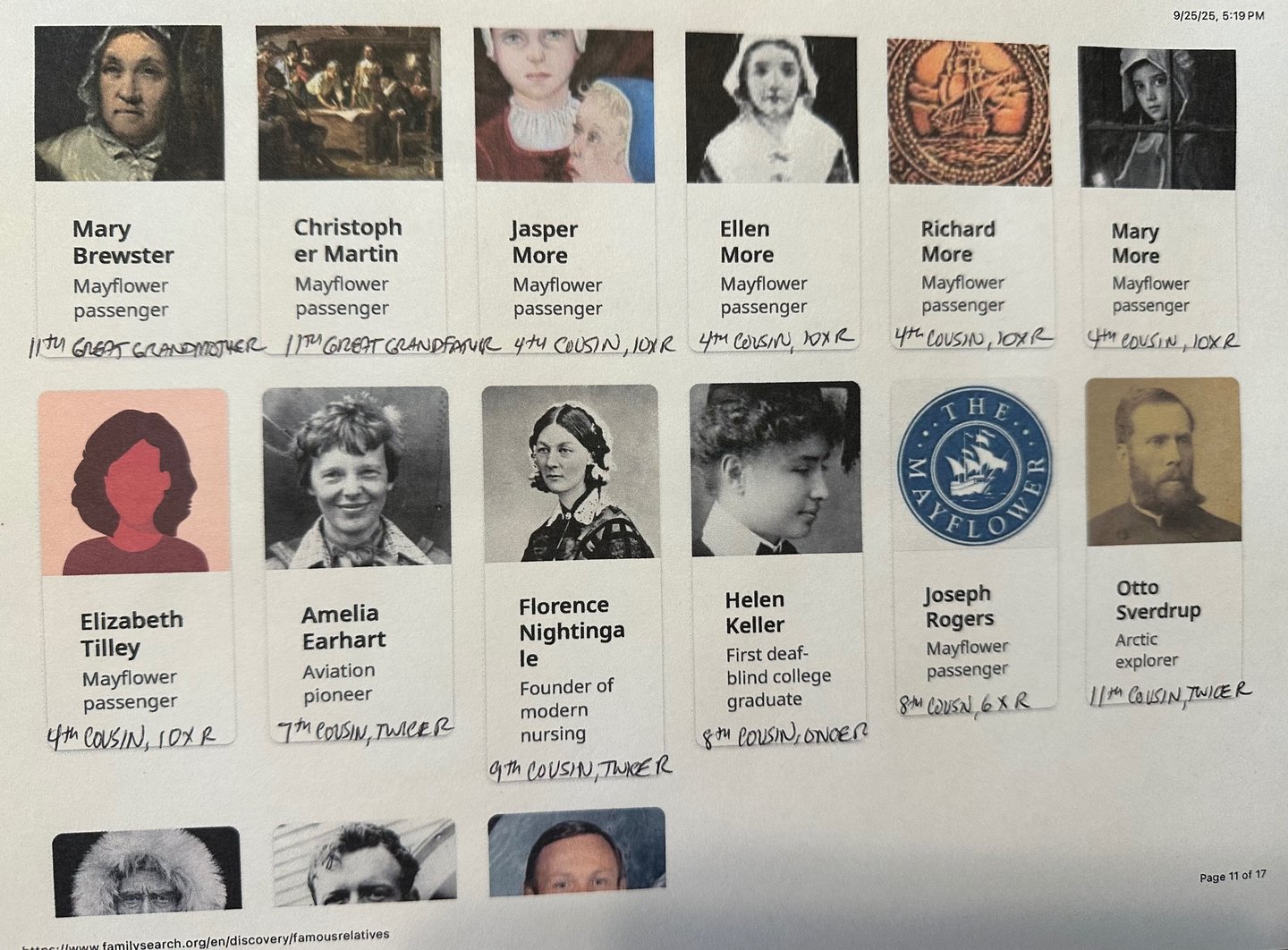
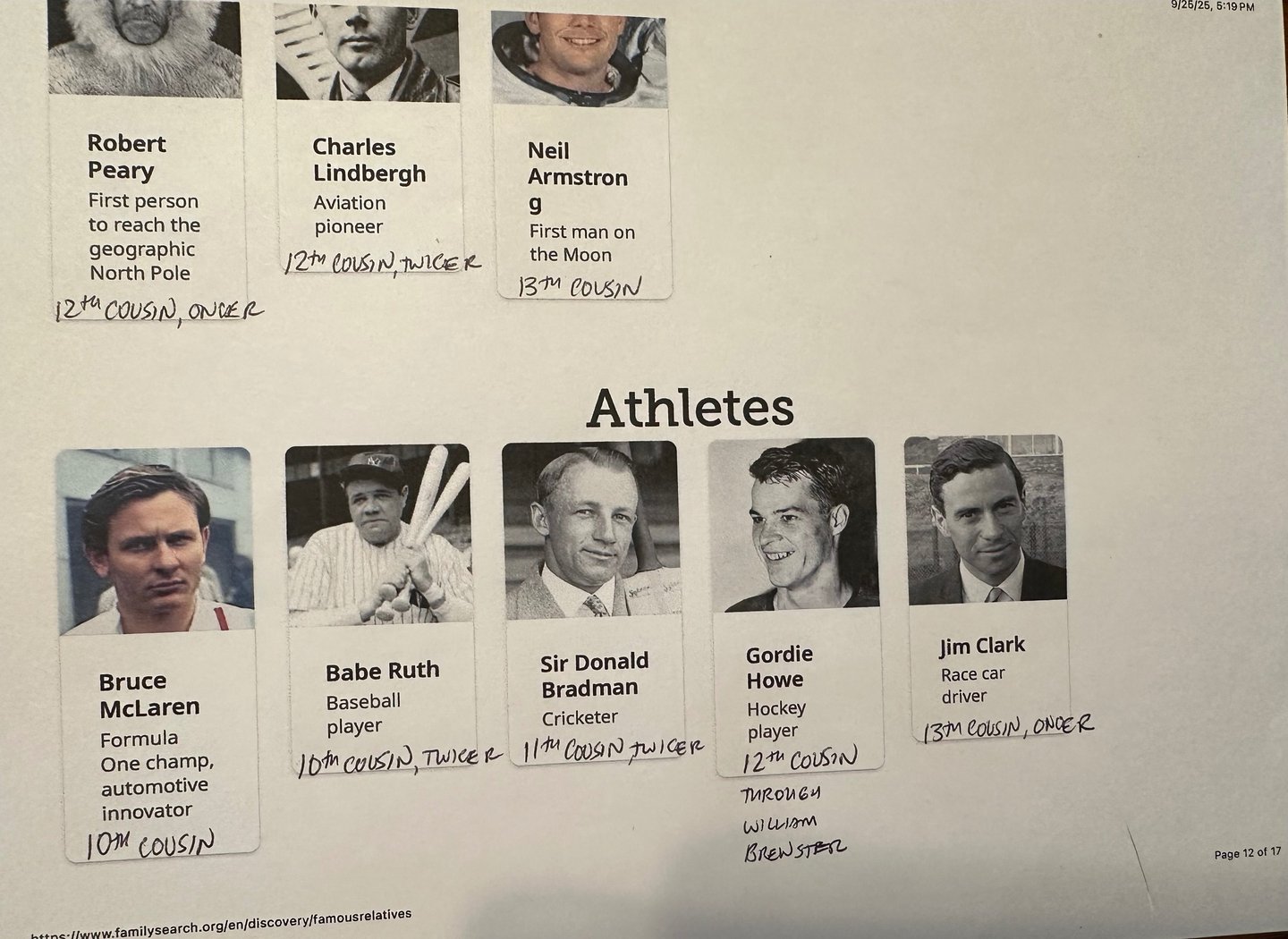
Chapter One: Amazingly, Familysearch.com tells me that I am related to 33 US. Presidents, Winston Churchill, Lady Diana, and many famous entrepreneurs and entertainers such as Walt Disney and Marilyn Monroe. It's a who's who of famous people including two Beatles!
Chapter Two: highlights our families involvement in the Salem Witch trials through my direct descendant Mehitable Brabrooke. Mehitable's husband John Downing is a direct descendant whose brother was George Downing of 10 Downing Street!
Chapter Three: highlights the supposition that one of our early American ancestors married an Indian, and that the O'Rear family has a very small part Indian blood.
Chapter One: Famous Ancestors
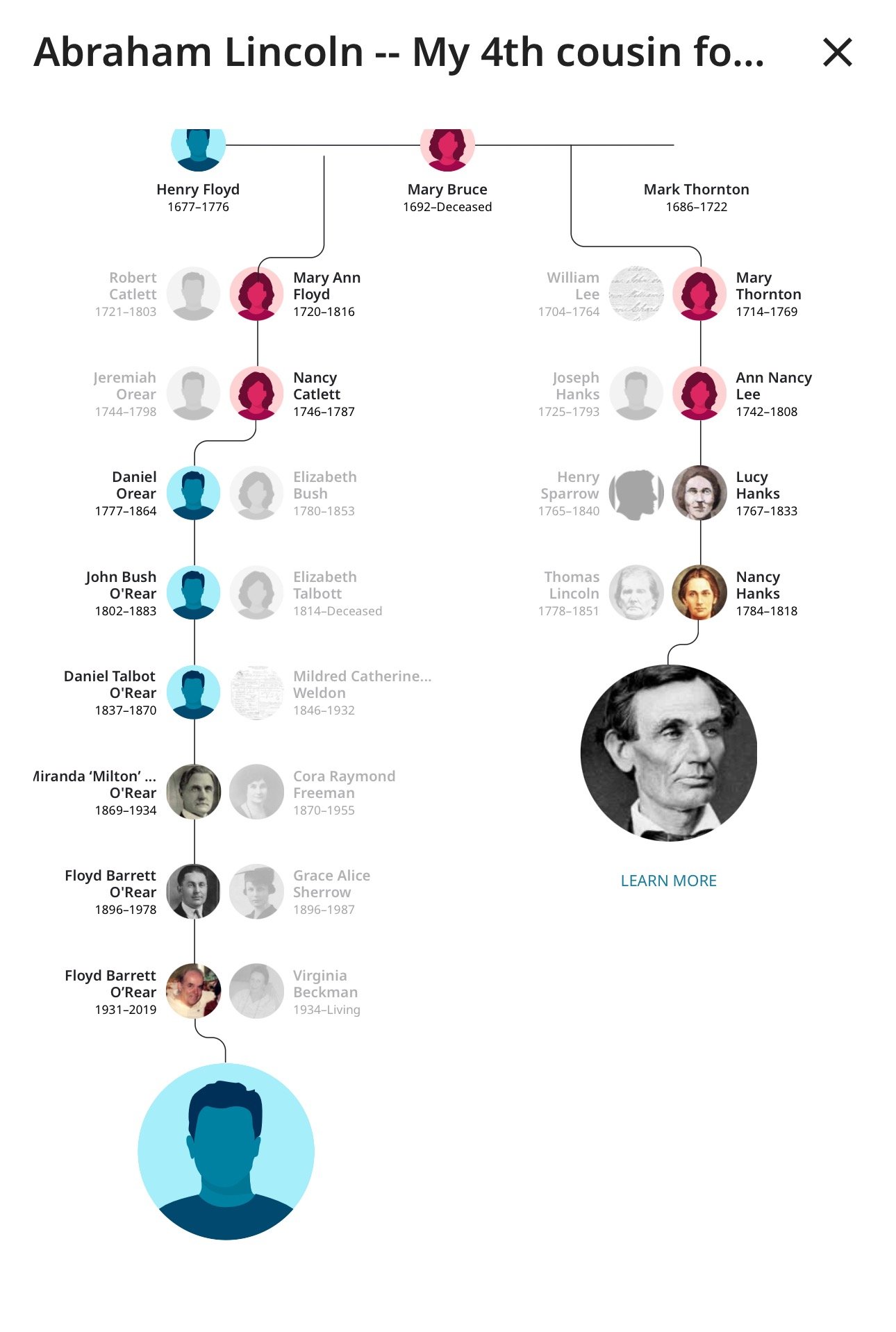
Abraham Lincoln is my 4th Cousin, 4XR (meaning four times removed). Below is the exact linage path taken from Familysearch.com, and below that a chart which helps explain the mystery of what four times removed means!
P


I have discovered that Lord George Calvert, the first Governor of Baltimore is my 10th GG on my father's side. Below is the lineage path:
Lord George Calvert, 1st Lord Baltimore, 1579-1632
10th great-grandfatherLady Grace Calvert Talbott 1611-1672
Daughter of Lord George Calvert, 1st Lord Baltimore, Under-Secretary & Secretary Of State IRichard Talbott 1630-1699
Son of Lady Grace Calvert TalbottJohn Talbott 1658-1707
Son of Richard TalbottEdward Talbott 1723-1797
Son of John TalbottJohn Talbott 1748-1825
Son of Edward TalbottRichard Talbott 1788-1823
Son of John TalbottElizabeth "Betsy" “Betty” Talbott 1814-1895
Daughter of Richard TalbottDaniel Talbott O'Rear 1838-1870
Son of Elizabeth "Betsy" “Betty” TalbottMiranda Allen (M. A.) O'Rear 1869-1934
Son of Daniel Talbott O'RearRev. Floyd Barrett O'Rear Sr 1896-1978
Son of Miranda Allen (M. A.) O'RearRev. Floyd Barrett O'Rear Jr. 1931-2019
Son of Rev. Floyd Barrett O'Rear SrMark Edward O’Rear
You are the son of Rev. Floyd Barrett O'Rear Jr.
Lord George Calvert, 1st Baron Baltimore, is a historically significant figure known for his role in the early establishment of the Maryland colony in North America during the early 17th century. Born in 1580 in England, Calvert was a statesman and a prominent political analyst whose vision for religious tolerance and colonization played a crucial role in shaping the future of what would become the United States. His contributions are particularly noteworthy for their impact on religious freedom and governance, which resonate through American history to this day.
Early Life and Political Career
Calvert was born into a Catholic family at a time when England was predominantly Protestant and Catholics faced significant discrimination. He was educated at Trinity College, Cambridge, where he developed a strong sense of loyalty to the Crown and Catholic values. His political career began in earnest when he was appointed as the Secretary of State to King James I in 1625, a position that provided him with insight into the intricacies of politics and governance.
Throughout his early political endeavors, Calvert remained committed to his faith, which frequently put him at odds with Protestant majorities in power. His staunch Catholicism led to his gradual withdrawal from public office, culminating in his resignation from the Secretary of State position. However, his dedication to promoting Catholic rights and securing a haven for his fellow Catholics became a driving force in his life, propelling him forward toward colonization efforts.
The Vision of Maryland
In the 1620s, Lord Baltimore turned his attention to the New World as a potential refuge for English Catholics facing persecution. The Virginia colony, ~established in 1607, was predominantly Protestant, leaving little room for dissenting opinions and religious practices. Recognizing this void, Calvert sought and was granted a charter by King Charles I in 1632, which established the Colony of Maryland.
Maryland was uniquely intended as a haven for Catholics, and Calvert envisioned it as a society where religious tolerance would flourish. The charter allowed him significant control over the colony's governance, which he used to set a precedent for the religious freedoms that would characterize Maryland. His aim was not merely to create a colony but to develop a model for governance that would support pluralism.
Establishing the Colony
The first settlers arrived in Maryland in 1634, bringing with them the ideals and structure that Calvert had envisioned. Among them was the first governor, Leonard Calvert, George Calvert's son. The settlers constructed St. Mary’s City, which became the first capital of Maryland. Despite the myriad challenges faced, including conflict with local Native American tribes and harsh environmental conditions, the colony began to take shape under Calvert's principles of governance.
One of Lord Baltimore’s most significant accomplishments was initiating the Maryland Toleration Act of 1649, which granted freedom of worship to all Christians, a groundbreaking decision in an era marked by sectarian violence. Although a step toward tolerance, it primarily benefited Christians rather than other religions, reflecting the complexities of Calvert's vision.
Relationship with Native Americans
Calvert’s approach to Indigenous relations was exceptional for his time. Early on, he sought to establish cordial relationships with local Native tribes, particularly the Yaocomico and the Piscataway. He emphasized negotiations over hostility; Calvert was aware that the colony's success hinged on cooperation and mutually beneficial interactions.
By securing peace treaties and trade agreements, Lord Baltimore aimed to stabilize the colony. However, the growing population of settlers and land pressures eventually led to many conflicts with Native groups, reflecting the complex dynamics of colonial expansion and Indigenous rights—a theme that would continue to shape American history.
Legacy and Historical Importance
Lord George Calvert's legacy is multifaceted. As a proponent of religious tolerance, he laid the groundwork for the principles of freedom and conscience that would be echoed in later constitutional developments in the United States. Although Maryland’s religious landscape evolved over the centuries, his early efforts for a tolerant society allowed it to become a refuge for various religious groups.
Moreover, Calvert’s governance style became an early example of colonial administration, emphasizing rights and privileges for settlers that would influence North American colonial governance frameworks. His charter was distinct in providing a degree of autonomy that later colonial leaders would adopt.
Furthermore, Lord Baltimore's vision extended beyond the simple exercise of power; it encapsulated a philosophical debate about the nature of authority, religion, and governance that would shape not only Maryland but also the broader discourse in America. His efforts signified a progressive understanding of societal governance in a time when the prevailing norms dictated exclusion and intolerance.
Calvert’s colonization initiatives also underscore the complex narrative of North American settlement, marked by both the pursuit of opportunity and the often-overlooked consequences for Indigenous populations. His experiences serve as a lens through which to explore the themes of power, religion, and ethics in colonial America, and raise questions about the frameworks we use to evaluate historical figures today.
Conclusion
In summary, Lord George Calvert, 1st Baron Baltimore, is an historically essential figure whose life and legacy contributed significantly to the foundations of religious tolerance, colonial administration, and Indigenous relations in America. He represents the intricate dance between aspirations for freedom and the realities of colonial expansion during a pivotal time in history. His vision for Maryland continues to echo through the values that underpin modern American society, making his contributions not only relevant to his time but essential to our understanding of the evolution of freedom and governance.
How could anyone be related to 33 U.S. Presidents?
As mentioned, Ancestrysearch.com tells me that I am related to 33 U.S. Presidents. To be related to that many U.S. presidents would not only raise eyebrows but also spark a myriad of questions about the intersections of heritage, genealogy, and the very nature of familial ties among that many of the most influential figures in American history.
Firstly, we must consider the total number of presidents that the United States has had since its inception in 1789. As of October 2025, there have been 47 presidents, which makes the idea of being related to a substantial fraction—more than two-thirds—of this group pretty rare.
Most family trees show a linear connection, usually narrowing down over generations. The sheer number of presidents derived from the same familial line suggests not just intermarriages and longstanding connections, but also might reflect broader complexities in genealogical history. It hints at a mixing of bloodlines among families that have consistently held political power, social privileges, or wealth in American society.
One of the main reasons for this is because both sides of my family arrived in the Unites States in the 1600's. This means that there is ample opportunity for many connections to have occurred. Genealogical research has revealed that certain last names appear frequently within presidential lineages. For example, the blood relation between various presidents might be traced directly to the branches of early settlers or revolutionaries, where a not-insignificant amount of U.S. history converges into specific family groups. To be related to so many presidents would likely involve significant historical research, possibly uncovering direct blood relations or ancestral links that may not be evident in common oral histories.
While it is not impossible for an individual to claim relation to 33 U.S. presidents, an individual who has very early U.S. colonial ancestors from both the Mayflower and Jamestown could potentially achieve it. It must be added that the age of AI and computerization of ancestry lineage makes the determination of such lineages much more readily possible. It is unthinkable even ten or twenty years ago, for instance, that one could research such a lineage.
All of the Famous Ancestors below are directly from Familysearch.com.
Chapter Two: Salem Witch Trials
Perhaps the most unexpected geneology finding was that my 8th Great Grandmother, Mehitable Brabrooke, was tried and found guilty of witchcraft as part of the Salem Witch trials.
Setting the Stage: Puritan Fear and Societal Stress
In 1692, the village of Salem in the Massachusetts Bay Colony was a tightly woven Puritan community cast under a heavy shadow of religious fervor, mistrust, and harsh day-to-day realities. The colony faced numerous stresses: smallpox epidemics had recently ravaged the population, tensions with Native American tribes simmered, and internal disputes about land, social rank, and church politics frayed neighborly relations.
Puritan theology held firm beliefs about the devil’s active presence in the world and the real possibility of witches conjuring his power to harm the godly. Such fears, compounded by social rivalries and hardships, created conditions ripe for paranoia and scapegoating.
The First Signs: Afflicted Girls and the Spark
In January 1692, the village minister’s daughter, nine-year-old Elizabeth “Betty” Parris, and her eleven-year-old cousin Abigail Williams began experiencing terrifying fits of screaming, convulsions, and contortions. Local doctor William Griggs, unable to find a physical cause, surmised witchcraft was involved. This diagnosis validated Puritan fears and launched the community into a frenzy of suspicion.
Soon other children in Salem Village exhibited similar fits, and accusations rapidly escalated. Under pressure from ministers and townspeople, Betty and Abigail named Tituba, the Parris family’s Caribbean slave, as the source of their torment—a confession that ignited the trials.
The Tide of Accusations
Within weeks, neighbors Sarah Good and Sarah Osborne were also accused, beginning a firestorm of allegations. Over 150 people across Salem and surrounding towns would eventually be accused, many imprisoned in horrid conditions.
The accused faced “spectral evidence”—claims that afflictions came from the invisible spirit or shape of the accused—as key proof. The girls would writhe and point, claiming attacks by unseen assailants.
Court of Oyer and Terminer: The Legal Machinery of Tragedy
Governor William Phips established the Court of Oyer and Terminer on May 27, 1692, to hear witchcraft cases. Presided over by Lieutenant Governor William Stoughton, the court accepted spectral evidence and provided no legal counsel for defendants.
Accused people were torn between confessing—hoping mercy—or proclaiming innocence and facing certain death. The community watched as neighbor turned accuser, friendships dissolved, and fear permeated every trial.
Executions and Martyrs
• June 10, 1692: Bridget Bishop, a woman known for her assertiveness and unconventional behavior, was hanged—the first of 19 executed accused witches.
• July 19: Five more were hanged, including Rebecca Nurse, an elderly woman of great respect, whose conviction shocked many.
• August 19: George Burroughs, former Salem Village minister, was executed after being accused as the ringleader of witchcraft.
• September 22: Eight were hanged, including Martha Corey. Her husband Giles Corey died under pressing after refusing to plead.
The executions tore families apart and sent chilling ripples of terror through Salem.
The Ordeal of Mehitable Brabrooke Downing
Among those swept into the hysteria was Mehitable Brabrooke Downing, Mark O’Rear’s 8th great-grandmother. Mehitable, already burdened by a troubled past including a conviction for arson, found herself a target in an atmosphere hungry for scapegoats.
Imprisoned in Ipswich’s cold, vermin-ridden jail, Mehitable endured months isolated from family and community. Her accusers likely included neighbors embroiled in property disputes and family rivalries.
A hypothetical testimony might read, “I saw the specter of Mehitable Braybrooke tormenting me with unholy whispers and chilling touches in the night.” Accusations could never be disproved, and many accused faced death without trial.
Unlike others who were executed, Mehitable survived as courts became skeptical of spectral evidence. Her resilience marks a rare victory amid widespread injustice.
The Collapse of the Trials
By fall 1692, voices against the trials grew louder. Increase Mather, president of Harvard and Cotton Mather’s father, publicly questioned spectral evidence’s validity. Governor Phips dissolved the Court of Oyer and Terminer in October, replacing it with a Superior Court that disallowed spectral evidence.
Accused persons were released or pardoned, and by 1693 the hysteria ended.
Aftermath and Legacy
The Salem Witch Trials resulted in 19 executions, one pressing to death, and many deaths in prison. Survivors and their families carried the scars for generations.
In 1697, the Massachusetts General Court declared the trials unlawful and formally expressed remorse. Families of victims received reparations. Salem’s dark chapter is now memorialized as a cautionary tale against mass hysteria, injustice, and violation of due process.
The Human Story
For Mehitable Brabrooke Downing, the accusation meant years of suffering, suspicion, and social stigma. As an ancestor of Mark O’Rear, her story humanizes a historic tragedy and anchors the past in personal survival amidst chaos.
Here is the lineage:
Mark O’Rear (me)
• Born 1957
• Son of Virginia Beckman (b. 1934) and Floyd Barrett O’Rear Jr.
Virginia Beckman (mother)
• Born 1934
• Daughter of Marion Frances Bee (b. circa 1913) and Albert A. Beckman
Marion Frances Bee (grandmother)
• Born circa 1913
• Daughter of Lilla Gertrude Thurston (b. circa 1878)
Lilla Gertrude Thurston (2nd Great Grandmother)
• Born circa 1878
• Daughter of John Albert Thurston (b. 1842) and Eliza Sparrow Downing (b. circa 1809)
John Albert Thurston (3rd Great Grandfather)
• Born 1842
• Married Eliza Sparrow Downing
• From the established Thurston family of colonial Massachusetts.
Eliza Sparrow Downing (3rd Great Grandmother)
• Born circa 1809
• Daughter of Smith Downing (b. 1779) and Hannah Jacobs
Smith Downing (4th Great Grandfather)
• Born March 17, 1779, Boston, Massachusetts
• Son of John Downing Jr. (5th Great Grandfather)
John Downing Jr. (5th Great Grandfather)
• Born 1733
• Father of Smith Downing
John Downing Sr. (6th Great Grandfather, baptized July 25, 1708, Gloucester, MA)
• Son of David Downing and Susanna Roberts
• Married Tabitha Deland (b. November 25, 1706) in 1731, Newbury, MA
• Children include John Downing Jr. (b. 1733), Susanna Downing (b. 1734), David Downing (b. 1738), Moses Downing (b. 1742)
• Died circa 1743 Newbury, Massachusetts (some sources list 1777 Springfield, MA)
David Downing (7th Great Grandfather, b. circa 1677 – d. 1723)
• Son of John Downing (b. circa 1640) and Mehitable Braybrooke
• Conveyed half of family farm to son David in 1699
• Married Susanna Roberts in 1701
• Father of John Downing Sr. and other children
John Downing (8th Great Grandfather, b. circa 1640 – d. after 1714)
• Son of Emanuel Downing (b. 1585) and Lucy Winthrop (b. 1601)
• Married Mehitable Brabrooke (b. c. 1651) in 1669
• Owner of substantial Ipswich landholdings
• Accused during Salem Witch Trials, survived
Mehitable Brabrooke (8th Great Grandmother, b. c. 1651 – 1721)
• Born circa 1651 in Salem, Massachusetts
• Illegitimate daughter of Richard Brabrooke (b. c. 1613) and Alice Eliss
• Married John Downing in 1669 (8th GG)
• Convicted of arson in 1668; sentenced to whipping and fines
• Accused in the 1692 Salem Witch Trials, imprisoned but released without trial
• Died 1721
Emanuel Downing (9th Great Grandfather, 1585–1660)
Emanuel Downing was John Downing’s father and was a Cambridge-educated attorney and ardent Puritan born in Ipswich, Suffolk, England in 1585. He was a close relative of Governor John Winthrop, marrying his sister Lucy Winthrop, thereby connecting the Downing family directly to one of the most influential families in early Massachusetts colonial history.
Emanuel emigrated to Massachusetts Bay Colony in 1638, where he became a respected figure in both political and religious circles. He was a deputy in the Massachusetts General Court and served in various local capacities. His Puritan ideals and leadership helped shape the colony during its early turbulent years.
He fathered John Downing (b. circa 1640), who would carry forward the family legacy in New England.
George Downing (Brother of Emanuel Downing, c. 1623–1684)
George Downing, my 8th Great Granduncle was the brother of Emmanuel. He was born circa 1623, and was a distinguished English soldier, diplomat, and politician. He served under both Oliver Cromwell and King Charles II, navigating the tumultuous politics of mid-17th-century England.
George was knighted and created a baronet, amassing significant estates. Notably, he built the house that became Downing Street in London, now synonymous with the British Prime Minister’s official residence.
His will famously included the founding of Downing College, Cambridge. Though legal battles delayed the actual establishment, the college was chartered in 1800, cementing the Downing family’s legacy in British education and society. He built 10 Downing Street, and it is named after him!
References
1. Salem Witch Trials Documentary Archive and Transcription Project, University of Virginia
2. Encyclopaedia Britannica, “Salem Witch Trials,” 2025
3. Historic Ipswich Blog, Mehitable Brabrooke Downing, 2021
4. Donna B. Gawell, In the Shadow of Salem, 2018
5. Massachusetts Historical Society Primary Court Records
6. Wikipedia, “Timeline of Salem Witch Trials,” 2007
7. Peabody Essex Museum, “The Salem Witch Trials of 1692,” 2023
8. Salem Witch Museum, Chronology, 1999
9. Wikipedia, “Sir George Downing, 3rd Baronet,” 2008
10. Downing College History, University of Cambridge
I recieved the following personal email from Donna Galwell the author of a documentary book on Mehitable Brabrooke entitled "In the Shadow of Salem". I purchased her book and asked her to clarify some confusion as to whether Mehitable’s husband John Downing was the son of the famous Emmanuel Downing.
"Hi Mark! To answer your question, the John Downing of Ipswich, MA,. who married Mehitabel Brabrooke, was born about 1640, and MAY have been, and probably was, the son of Emanuel Downing and Lucy Winthrop. BUT ..he did not die in 1694, but was alive in 1714 when his son-in-law Thomas Lufkin posted a bond for the suppport of his 'revered father and mother', according to Ipswich Town Records. (See Thomas Waters. Ipswich in Mass Bay Colony, 1905, Vo 2, 253) John and Mehitabel deeded portions of their 200 acre farm to sons David, John and son-inlaw Thomas Lufkin from 1690-1705 (see LDS micro films #066021, #866021, #08866088 and #0899618)
The John Downing who died 4-24,1694 was a merchant from Nevis in the Caribbean,(from Barbados in 1679) , who moved to Boston to educate his son, Nathaniel in 1689. After extensive research, it is deemed highly improbable that he is the son of Emanuel Downing and Lucy Winthrop, as there is no evidence whatsoever, of his being in contact with their daughter, Anne Downing Gardiner Bradstreet, wife of Gov Simon Bradstreet who was living in Salem, or Lucy Downing Norton of Hingham.(supposedly his sisters). Contemporary gossip diarist, Judge Samuel Sewall, did not recognize him, altho he was intimately acquainted with both Winthrop and Downing fmilies of the West Indies, and in the Bay area. Renowned historian and genealogist Eben Putnam in 1898 tried, and failed, to find any relationship with Elizuer Holyoke, who Nevis John claimed to be his kinsman.(Manuscipt collection NEGHS)
Unless there is corroborated data, ie, more than the 73 word deposition of the Irish John Downing (Essex County Court Record 6-117-173), there is no proof either that this was the John Downing who married Mehitabel Brabrooke in 1669. Whether Irish John was an indentured servant, was married, was born in 1638 or before, or even an inhabitant of Ipswich must be verified.
Finally, Sidney Perley, editor of the Essex Antiquarian and the two volume Histor of Salem, in notes( Essex Amtiquarian 11:141) about the deed by Richard Brabrooke giving one half of his farm to John Downing 'in consideration for a marriage to be performed' called John Downing 'planter', a social standing title indicating possession of more than 150 acres of land (Edward Perzel's doctoral thesis The First Generation of Settlement in Colonial Ipswich 1633-1663 published in 1967) Ipswich farmer John Downing, if indeed son of Emanuel Downing and Lucy Downing, would have been an heir to Emanuel's 600+ acre farm in nearby Salem which was in the Downing family name until 1702. Perley would not have dignified the Irish John Downing with this title."
Chapter Three: Indian Blood
The O’Rears may have Indian blood!
John Basse is my 8th Great Grandfather.
NOTE: The following family lore is based almost solely on a family bible record. This is not enough proof and documentation for the Jamestown Society, but is nonetheless well documented by the Nanosend Indian tribe and family records.
John Basse was born in London, England on September 7, 1616, the third of a dozen children born to Nathaniel and Mary Jordan Basse. Little could anyone know that this well-born English child would be the sole survivor of an enormous massacre in a far-away land, that he would be raised as a member of an Indian tribe, that he would marry an Indian princess, have eight children with her, live to the age of 85, and have countless descendants, many of whom would still tell his story four hundred years later. But he was born in a time of change, and this great adventure was his destiny.
Three months before John’s birth, the exotic Indian princess, Pocahontas and her English husband, John Rolfe arrived in England amid great fanfare along with the very first shipment of tobacco from a far away colony in a little-known place called Virginia. Only nine years earlier, the first intrepid band of English adventurers had established a settlement there called Jamestowne. It was to become the first permanent settlement of English speaking peoples in the New World.
John’s grandfather, Humphrey Basse and his brothers, William and Thomas were French Huguenots who immigrated to London during the reign of Elizabeth I seeking religious freedom. Humphrey married Mary Bouchier, daughter of Dominick and Genevieve Bouchier, also French Huguenots. Humphrey was an entrepreneurial man, first as a merchant haberdasher, and then as an investor and stockholder in the Virginia Company which financed settlements in Jamestowne, Virginia. Humphrey invested in the Third Charter of the Virginia Company signing as a founder on March 12, 1612.
Arriving in Virginia
In 1619 when John was three years old, his father, thirty-year-old Nathaniel Basse made his first trip to the new colony. On April 27, 1619 Nathaniel arrived at Jamestown on Captain Christopher Lawne’s ship. They brought workmen, supplies and one hundred settlers. Their camp was at the mouth of a creek near Jamestown, still named, Lawne’s Creek, from which they built the first settlement in Isle of Wight County, Virginia.
By mid-summer 1619, there were about a thousand English living in Virginia. In early August, the first legislative assembly in America met in the church at Jamestowne. This meeting established the principle of elected self-rule in America and became a foundation of our Republic. Five months later, the Virginia Company dissolved its subsidiary company which had been formed to exclusively supply the colony. Thereafter, free trade prevailed in the colony and laid the foundation for free enterprise as the form of the American economy.
Nathaniel made frequent trips between Virginia and London over the next few years. On November 21, 1621 he made his move to establish a home in the New World and patented 400 acres on the James River at Pagan Creek in Isle of Wight County. Here he founded Basse’s Choyce Plantation and built a home for himself and his young family.
John’s maternal grandfather, Silas Samuel Jordan was also an early Virginia Adventurer. In 1620 he received a grant of land on the James River at Bailey’s Creek near the present Hopewell, Virginia. Here, at what is still called Jordan’s Point, he and established a home for his family in the New World
Indians kept a close watch on the English settlers.
Throughout this period, relations with the Indians had been volatile. Early encounters had been hostile, and then the “Peace of Pocahontas” gave the settlers a sense that conditions would remain amenable.
Having established Basse’s Choyce Plantation, John’s father began to move his family to Virginia. In early 1622, six-year-old John Basse along with at least one of his brothers were at Basse’s Choyce when their parents made a return trip to England.
And then disaster struck. Emperor Powhatan (father of Pocahontas) had died four years earlier and had been succeeded by his brother, Opechancanough. He wanted no part of the white men and he patiently organized a surprise attack that was carried out by almost every tribe in the area. On the same day, at the same time, and anywhere there was a white man, he was to be killed.
Virginia Indians attack the colony, March 22, 1622
At midday on Good Friday, March 22, 1622, there were twelve hundred forty English inhabitants in the Colony of Virginia. Of these nearly four hundred were killed by Indians. At the house of Captain John Basse, only six-year-old John Basse survived. John’s oldest brother seven-year-old Humphrey and possibly other siblings were killed in the attack.
John’s parents, Nathaniel and Mary arrived back in Virginia on the ship Furtherance within the next couple of weeks only to find their oldest son (and possibly others) killed in the massacre, and six-year-old John was missing without a trace. They found the woods around the English settlements patrolled by hostile Indians.
Nathaniel and Mary had little time to mourn because Basse’s Choyce had to be immediately repaired for the birth of another child. On May 8, 1622 their sixth child, Edward, arrived. To make matters even more dire, in December an epidemic arrived with the ship Abigail, and killed twice as many people as the Indian attacks. The colony also had a poor harvest that year and experienced another “starving time” throughout the winter of 1622-23. Less than 500 survived to see the spring of 1623.
Amid the carnage that happened that fateful Good Friday, young John Basse managed to slip away from the attackers and into the forest. Fortune smiled on the boy as he was found and taken in by friendly Nansemond Indians who were fleeing from the hostilities. His rescuers managed to reach the Nansemond River with John before their enemies had organized patrols in the woods.
John’s rescuers took him into their tribe and gave him advantages and standing. He absorbed the Nansemond culture. In spite of the danger, missionaries continued to teach the Nansemonds – including young John Basse – and he matured to become literate and a Christian.
By the time he was twenty-two John had fallen in love with a Nansemond girl whom he knew as Keziah Elizabeth Tucker, daughter of Chief Robin the Elder, but to the English she was the Princess Keziah Elizabeth, daughter of the King of the Nansemond Kingdom. On August 14, 1638 John and Keziah Elizabeth, age 14, were married. She was born about 1624 at Kecoughton, an Indian village in Virginia (now part of the city of Newport News). “Keziah” is an old testament name that can mean faithful or female equality.
Writing on the cover of the “Book of John Basse”
At some point during his remarkable lifetime, John acquired an English prayer book which served as his family Bible. In this book he recorded many important facts and events. This book exists today and is in the possession of his Nansemond tribe descendants
John Bass’ prayer book is a manuscript religious book of about 100 pages. It measures 4 5/8″ by 7 1/4″. The author’s name not known. The earliest date of a sermon entry is March 4, 1660. In ink on the cover is written “Book of John Basse Norfolk Co., Vir. A. D. 1675.”
John recorded the following passage in his prayer book:
“John Basse was born ye 7 day of September in ye year of our Lord 1616 ye son of Nathll Basse and Mary his wife… he married Elizabeth dafter of Robin the Elder, King of ye Nansimuns kingdom, a Baptized xtian, in Holy Matrimonie accdg to ye Canons of ye Church of England, ye 14th day of August in the Year of our Blessed Lord 1638.”
At some point it is believed John reconnected with his birth family because his brother Edward (born immediately after the massacre of 1622) married Keziah Elizabeth Tucker’s cousin.
John and Keziah were living in Nansemond territory when it became Upper Norfolk and then Nansemond County, Virginia. John passed away in 1699 at the age of 82 in Norfolk, Virginia. Keziah Elizabeth passed away in 1676 at the age of 52.
John and Keziah Elizabeth had eight children and today have countless descendants.
BASS Bible Record (Nansemond/Chowanoc)
The item below is from USGenWeb Archives (per citation at the bottom) and we have no further information about this document or this family.
Chowan County, NC - John Basse Bible Record ~~~~~~~~~~~~~~~~~~ Book of John Basse-Norfolk County Virginia NC Archives - Bibles Call No. 400.1.1.418
Nathaniell Basse and Mary Jourdan was marrid ye 21 day of May in ye yeare of our blessed Lord and Savior 1613
Humphrey Basse sonne of Nath'll and Mary Basse his wife was borned ye 15 day of ye month of July in ye year of our blessed Lord 1615, dyed in 1622
John Basse was borned ye 7 day of viiber in ye year of our Lord 1616, ye sonne of Nathaniell and Mary Basse his wife
William Basse sonne of Nathaniell and Mary Basse was borned on ye xxv day of Xber in ye year of our blessed Lord God 1618
Anthony Basse sonne of Nathaniell Basse and Mary his wife was borned on ye xiii day of March in Gods yeare of 1620
Edward Basse ye sonne of Nathaniell Basse and Mary his wife was borned ye 8th day of Maye in ye yeare of God 1622
Anne Basse the daughter of Nath'll and Mary his wife was born in ye yr of X't 1624, ye 9 day of Sber
Geneveve Basse ye daughter of Nathaniell Basse and Mary his wife was borned on ye 9 day of Sber in ye year of our blessed Lord God 1624, about ten minutes after Anne was borned Blessed be God for His tender Mercies. Amen
Humphrey Basse sonne of Nath'll and Mary dyed ye 22nd day of March in ye yeare of our Lord 1622
John Basse married ye dafter of ye King of ye Nansemund Nation, by name Elizabeth in Holy Baptism and in Holy Matrimonie ye 14 day of August in ye yeare of our blessed Lord 1638
William Basse sonne of Nath'll and Mary Basse was married to Sarah Batten ye 20th day of September in ye yeare of our Lord 1641 A.D.
This portion may have been written later or transcribed
Edward Basse sonne of Nath'll & Mary Basse yt unregenerated by the Spirit of God took in marriage one virtuous Indian mayd'n by the Christian name of Mary Tucker and went to live amongst the Shownanocs in Carolina in 1644 A.D. - He went to Carolina in later years in persute of trade and not in 1644
This the Book of John Basse - Steal it not...
John Basse borned in 1616 - John Basse dyed in 1699 A.D. Norfolk County Virg'a This doth certify that William Bass, son of John Bass and grandson of William Bass, is of English and Indian descent and is not a Negroe nor y't a Mulattoe as by some lately and malitiously stated. His late Mother Sarah Ann Bass was a virtuous woman of Indian descent, a daughter of Symon Lorina and Joan Tucker lawfully begotten. Sd Joan Tucker was a sister of Robin Tucker a Christian Indian of ye Nansemund nation. Ye sd William Bass, ye elder, was a son of Mary Bass and William Bass, Senr. Mary Bass was a daughter of Great Peter, King of ye Nansemunds. These are of common knowledge. All of the Basses of this County descend from Capt'n Nathaniell Basse, as satisfactorally proved by the records preserved May ye 17, 1797
Test: Wm Portlock